Understand how JC, Millennia Institute, IP, the IB Diploma, polytechnic and ITE fit into Singapore’s education pathways, with the 2027–2028 changes and university test requirements explained.
There are several routes from school to university in Singapore. Your child might go through a junior college or Millennia Institute, apply with a polytechnic diploma, or join a six-year Integrated Programme that leads to A-Levels, the IB Diploma or the NUS High School Diploma. Each route has its own entry requirements. MOE’s post-secondary overview, MOE’s explanation of IP.
If you’ve been looking at schools and wondering how all those initials fit together, it helps to start with the bigger picture. One school talks about IP, another mentions IB, and advice from an older sibling may refer to examinations that are about to change. You don’t need to work out your child’s entire journey at once. First, understand the routes; then look more closely at the next decision your family faces.
We’ll walk through the main options below, including how IP and IB fit together and what to check if your child hopes to study locally or overseas.
Start with the big picture
Here’s how the main routes connect:
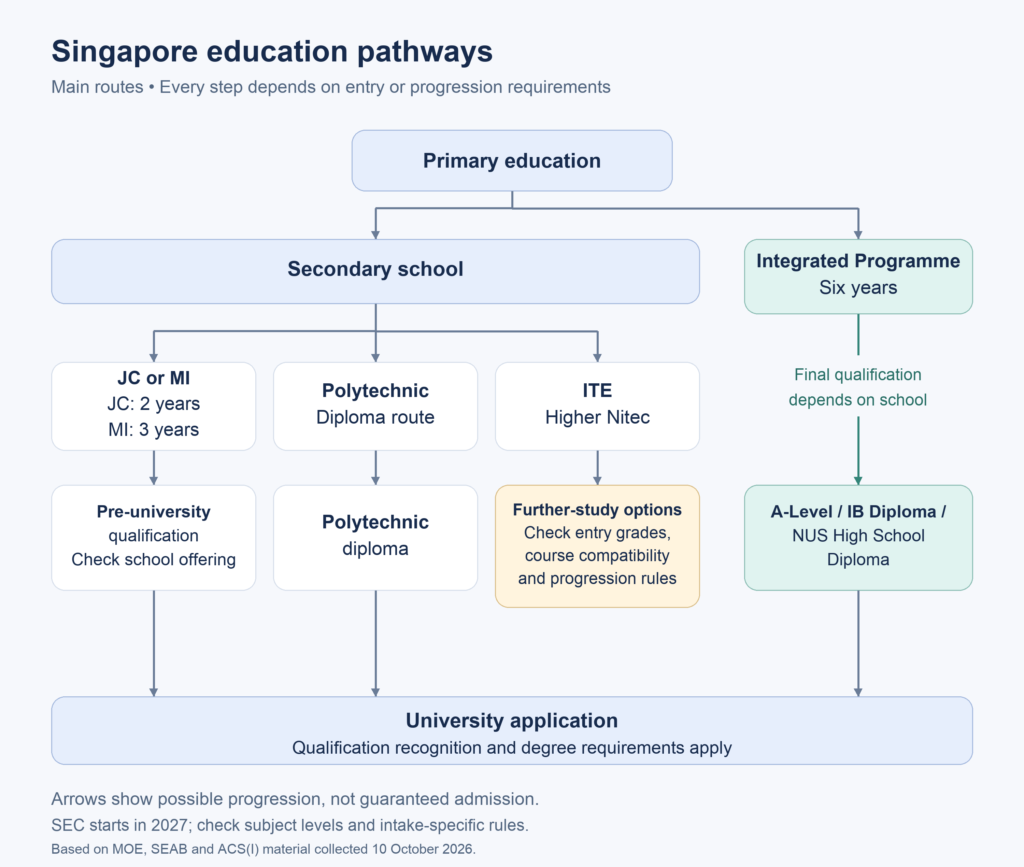
The map draws on MOE’s post-secondary overview and IP information. The arrows show possible next steps. Students still need to meet the requirements along the way.
When you read a school’s website, keep three things in mind:
| What you’re looking at | What it means | Examples |
|---|---|---|
| The institution | Where your child studies | JC, Millennia Institute, polytechnic, ITE |
| The programme | The route they follow | Integrated Programme |
| The qualification | What they earn and use for their next application | A-Level, IB Diploma, polytechnic diploma |
For example, “IP” tells you about the programme, but you still need to ask which qualification it leads to. That one question can make a school’s information much easier to follow.
Why the secondary-school year matters
If you remember O-Levels and N-Levels from your own school days, you’ll come across a new name when researching your child’s options: SEC, the Singapore-Cambridge Secondary Education Certificate.
From 2027, SEC combines and renames the N(T), N(A) and O-Level qualifications as part of Full Subject-Based Banding, often shortened to Full SBB. Students take subjects at G1, G2 or G3, and their certificate records both the subjects and the levels they took. SEAB’s guide to SEC.
The dates are easier to remember this way:
| When your child takes the examination | What to look for |
|---|---|
| Through 2026 | The N(T), N(A) and O-Level frameworks |
| From 2027 | SEC, with subjects taken at G1, G2 or G3 |
| January 2028 | Results for the first SEC examination cohort |
SEC results will be released in January of the following year. SEAB, MOE’s 2026 announcements.
For parents, the practical point is to check advice against your child’s year. A helpful explanation written for an older student may use rules or labels that don’t apply to yours.
The subject levels also matter when looking at the next step. Having a common certificate doesn’t mean every subject combination meets the same entry requirements. Before comparing post-secondary options, have your child’s subjects, levels and examination year beside you. This guide doesn’t list the full PSLE posting rules or admission score thresholds, so those need checking separately.
JC and Millennia Institute: continuing towards a pre-university qualification
A junior college (JC) offers a two-year course, while Millennia Institute (MI) offers a three-year course. When looking at a particular school, check the qualification its programme leads to. MOE’s post-secondary overview.
The journey can look like this:
Primary → Secondary → JC or MI → Pre-university qualification → University application
Alongside choosing a school, it’s worth thinking about subjects. If your child already has a few degree interests, look at their subject requirements before settling on a combination. NUS, for instance, asks applicants to meet the prerequisites of the degree programmes they apply for. NUS A-Level admissions.
Your child doesn’t need a fixed career plan to have that conversation. You could start with, “Which subjects would help you keep these interests open?” Then ask the school which combinations it offers and how they connect to possible university choices.
A place in JC or MI is one step in the journey. The later university application still depends on the qualification, results and requirements of the degree your child chooses.
IP and IB: how can a school offer both?
This is an easy point to get tangled up in. IP is the Integrated Programme, a six-year route. The IB Diploma can be the qualification at the end of that route. Other IP schools may lead to A-Levels or the NUS High School Diploma. MOE’s IP explanation.
So when you hear “IP or IB?”, first check whether the speaker means the school programme or the final qualification. They can be describing different parts of the same journey.
What that looks like at ACS(I)
Anglo-Chinese School (Independent), or ACS(I), provides a useful example. Students can enter its IP in Year 1 or Year 3, and take the International Baccalaureate Diploma Programme (IBDP) in Years 5 and 6. Its IP students do not take A-Levels and are exempt from SEC except for Mother Tongue. ACS(I)’s programme information.
For a student joining in Year 1, the route looks like this:
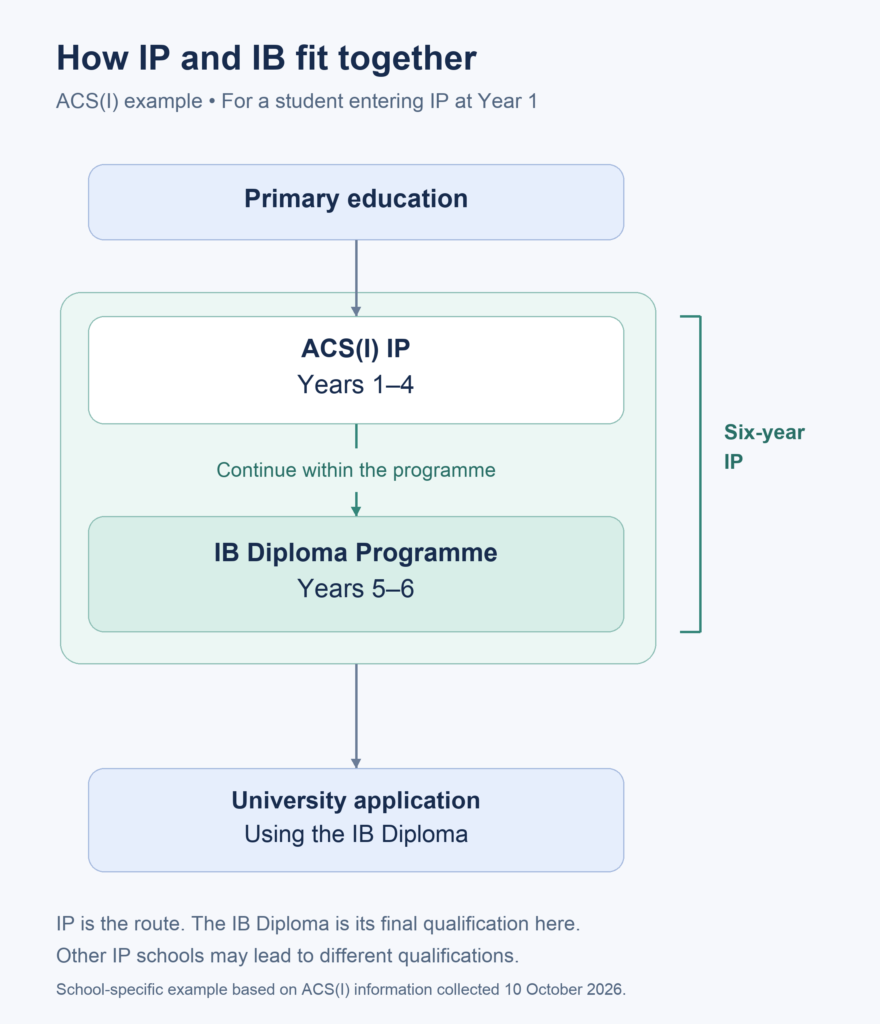
That’s why “Primary → IB → University” is only shorthand: it leaves out the secondary years and the programme connecting them to the diploma.
If your family is considering IP, ask about the whole six-year experience. Which qualification does the school offer? How does entry work? What happens if your child wants to change direction?
Those last questions deserve a direct conversation with the school. ACS(I), for example, expects students to commit to the full programme and strongly discourages transfers. Other schools’ arrangements need checking individually. ACS(I)’s IP information.
You don’t have to decide whether IB or A-Level is universally “better”. Begin with the actual school, its programme and the questions your child has about studying there.
Polytechnic, ITE and the other names you’ll come across
A polytechnic offers practice-based diploma education, and graduates may be considered for university admission using their diploma qualifications. That gives families another route to explore alongside pre-university study. MOE’s overview.
If your child is interested in a diploma course, look at both the course itself and where it might lead. For a possible university degree, check whether the university accepts that diploma and whether there are additional subject or course requirements.
You’ll also see ITE, the Institute of Technical Education, and Higher Nitec. MOE’s overview describes the transition of Nitec courses to a three-year Higher Nitec structure by academic year 2026. It lists two other names among polytechnic entry routes: the Polytechnic Foundation Programme (PFP) and the Direct-Entry-Scheme to Polytechnic Programme (DPP). MOE’s post-secondary overview.
For these options, the details of the course matter. This guide doesn’t set out PFP duration, DPP structure or the grades and course conditions needed to move from ITE into further study. That’s why the ITE branch in the diagram asks you to check the next step rather than drawing a single automatic path to university.
Take a few questions with you when speaking to the institution:
- What does my child need to enter this course?
- What qualification will they leave with?
- Which further-study options accept it?
- What results or other conditions would they need to progress?
You can explore the route without having every answer immediately. Just keep the questions about further study alongside the questions about entry.
Applying after secondary school: what changes in 2028?
There’s another name to know if your child will be applying for post-secondary study in 2028 or later: PSE, the Post-Secondary Admissions Exercise.
From 2028, PSE will replace current admission exercises for JC, MI, polytechnics and ITE two-year and three-year Higher Nitec courses. The change follows the first SEC results in January 2028. MOE’s 2026 announcements.
MOE says these application routes will continue:
- DSA-JC: Direct School Admission to junior colleges.
- Poly-EAE: Polytechnic Early Admissions Exercise.
- ITE-EAE: ITE Early Admissions Exercise.
For PSE applicants with the same net aggregate scores, the announced tie-breakers are citizenship, choice order, gross aggregate score and computerised balloting, in that order. MOE’s announcement
If someone shares advice about the Joint Admissions Exercise, or JAE, check which intake it refers to. Before filling in preferences, look at the process and eligibility rules for your child’s year. The new numerical entry thresholds aren’t covered here.
Does my child need SAT or ACT for university?
The answer depends on where they apply and which qualification they use. A country label such as “local” or “overseas” won’t tell you enough.
It helps to make a separate list for each university and degree. Record the qualification requirements, any required subjects, extra tests, language evidence and documents. Here are three university examples to show why those lists can differ.
Applying to NUS with Singapore-Cambridge A-Levels
For examinations in 2025 onward, NUS lists three H2 content-based subjects, General Paper (GP), a pass in Project Work (PW) and fulfilment of Mother Tongue Language (MTL) requirements. It also considers achievements, degree prerequisites and any required interviews or tests. NUS A-Level requirements.
SAT and ACT are not listed as universal requirements on that page. Read that as a description of the general requirements, rather than a promise that no extra assessment could apply. NUS also describes a separate SAT alternative concerning Law-related language requirements, with conditions that depend on the examination year. If that is relevant to your child, read the exact wording on the admissions page here – NUS.
Applying to NUS with the IB Diploma
NUS requires English to be an IB examination subject and applicants to authorise release of their IB transcripts. Degree prerequisites and possible interviews or tests still apply. NUS IB requirements.
Language requirements deserve a look too. English test results are required if at least three IB subjects are taught in a non-English language. MTL obligations depend on citizenship or residency and the school category. The page does not state a general SAT/ACT requirement for IB applicants.
What about NUS’s SAT, ACT and AP document?
You may come across a separate NUS document listing these combinations:
- At least five Advanced Placement (AP) courses.
- ACT with Writing plus at least three AP courses.
- SAT plus at least three AP courses.
The document also includes subject and official score-submission conditions. NUS standardised-test requirements.
Before planning extra exams around it, check whether it applies to your child’s qualification. This version was updated in December 2025 and includes May 2026 deadlines. It needs to be read alongside the relevant qualification page; it should not be applied to every A-Level or IB student.
Applying to Oxford
Oxford accepts Singapore-Cambridge A-Levels with AAA in three H2 subjects, including the subjects required by the course. H2 Knowledge and Inquiry cannot fulfil offer conditions. For IB, its requirements are 38, 39 or 40 points depending on the course, including core points and specified Higher Level grades of 6 and 7. Oxford’s international qualifications page
Oxford also accepts the NUS High School Diploma under specified conditions and considers Singapore Polytechnic Diploma case by case. Its page treats Singapore-Cambridge and international A-Levels separately, so find the entry that matches your child’s qualification. Oxford
These academic requirements are only part of the application. Check the chosen course for admission tests and English-language conditions as well. Oxford’s rules also shouldn’t be assumed to apply to another UK university.
Applying to MIT
MIT requires SAT or ACT for first-year and transfer applicants, while also collecting examination scores such as A-Level and IB. It does not require ACT writing or science, or the SAT optional essay. It publishes no SAT/ACT cutoff or recommended score. MIT’s testing information
MIT also conditionally recommends English proficiency results for certain non-native English speakers. That is not a blanket requirement for every student from Singapore.
Notice that MIT’s ACT requirements differ from the NUS document, which specifies ACT with Writing. The practical lesson is to check the exact test requirements before registering, including whether the document applies to your child’s application. MIT, NUS’s test document.
Keep the differences in one place
| Where your child might apply | What to check about tests | What else needs attention |
|---|---|---|
| NUS with Singapore-Cambridge A-Levels | SAT/ACT isn’t listed as universal; degree assessments and a Law-related alternative may apply | Examination year, required subjects and MTL |
| NUS with IB | No general SAT/ACT condition stated; degree assessments may apply | IB subjects, transcripts and language conditions |
| Oxford | Check the chosen course’s admission tests | Qualification-specific grades, subjects and English requirements |
| MIT | SAT or ACT is required | Other examination scores and any relevant English proficiency evidence |
Meeting a requirement makes an application possible; it doesn’t guarantee an offer. Use each university’s own rules when filling in your child’s list.
What you can do together now
You don’t need to choose every stage of your child’s education today. Start with the decision closest to you, and bring your child into the conversation.
What are they interested in learning? Which schools or courses would they like to understand better? What would they want to ask at an open house? Those questions can sit alongside the entry requirements, rather than getting lost behind them.
Here are two ways you might put that into practice. They’re planning examples, not accounts of particular students.
If your child is thinking about JC
Imagine your child has a few degree interests but hasn’t settled on one. Make a short list together, look up the subject requirements and ask the prospective JC about the combinations it offers. You’re gathering information for a choice, without asking your child to commit to a career.
If your child is considering local and overseas universities
An IB student looking at NUS and an overseas university could make one row for each destination. Add the required subjects, documents, extra tests and language evidence. Leave anything uncertain as a question to check before booking an examination.
For an ITE or diploma option, add questions about further-study entry conditions and whether the next course accepts the qualification.
A small planning sheet is enough to get started:
| Question | Your family’s notes |
|---|---|
| What is the next school, programme or course we’re considering? | Name and intended intake |
| What qualification does it lead to? | Exact qualification |
| What does our child need to enter and continue? | Requirements and questions for the institution |
| What might they want to study afterwards? | A few possibilities, if they have them |
| Are subjects, tests or language results needed? | Requirements for each destination |
| When do we need to decide or submit something? | Dates for the relevant intake |
Pick a few options to explore, fill in what you know, and take the unanswered questions to the schools or admissions offices. You can return to the plan as your child’s interests develop and the next decision gets closer.